How to File a Homeowners Insurance Claim: Step-by-Step Guide (2026)
A step-by-step guide to filing a homeowners insurance claim — what to do before, during, and after, plus documents, deductibles, and denied-claim options.

- Contact your insurance company as soon as reasonably possible after discovering damage.
- Document everything — photos, videos, a written inventory, and receipts — before making permanent repairs when practical.
- Understand your deductible and whether your policy pays replacement cost or actual cash value.
- Keep every document, photo, and communication until your claim is fully resolved.
This article is for general informational purposes and does not constitute financial, insurance, legal, or tax advice.
Table of Contents
- What Is a Homeowners Insurance Claim?
- What to Do Before Filing a Homeowners Insurance Claim
- How to File a Homeowners Insurance Claim Step by Step
- What Information Do You Need to File a Home Insurance Claim?
- What Happens After You File the Claim?
- What Does a Home Insurance Adjuster Do?
- Home Insurance Deductibles Explained
- Replacement Cost vs. Actual Cash Value
- How Are Homeowners Insurance Claim Payments Made?
- How Long Does a Homeowners Insurance Claim Take?
- Common Homeowners Insurance Claim Mistakes to Avoid
- What If Your Homeowners Insurance Claim Is Denied?
- When Should You Consider Filing a Home Insurance Claim?
- Homeowners Insurance Claim Checklist
A homeowners insurance claim can feel overwhelming right after you’ve discovered damage to your home. This guide walks through what to do before, during, and after filing a claim, so you know roughly what to expect at each stage. For a broader look at how coverage works, see our Home Insurance guides.
What Is a Homeowners Insurance Claim?
A homeowners insurance claim is a formal request to your insurance company for financial compensation after a loss you believe is covered by your policy — things like storm damage, fire, theft, or certain types of water damage.
When you file a claim, your insurer reviews what happened against the specific terms of your policy to determine whether the loss is covered, and if so, how much they’ll pay. Two concepts matter here:
- Coverage determination. Not every type of damage is automatically covered. Policies list covered perils and exclusions, and the cause of the damage often determines whether it’s covered at all — see our guides on what homeowners insurance typically covers and what it typically doesn’t for a fuller breakdown.
- Deductible. This is the amount you’re generally responsible for before your insurer pays the remaining covered amount. Deductibles can be a flat dollar amount or, for certain perils in some states, a percentage of your dwelling coverage — our deductible guide covers this in more depth.
Because policy language varies so much between insurers, states, and even individual policies, the details in this guide are general information. Your own declarations page and policy documents are the authoritative source for your specific coverage.
What to Do Before Filing a Homeowners Insurance Claim
A few things generally matter in the period right after damage occurs, before you formally file:
- Make sure everyone is safe first. If there’s an immediate danger — fire, structural damage, a gas leak — get everyone out and call emergency services before worrying about documentation.
- Prevent additional damage when it’s safe to do so. Reasonable steps like tarping a damaged roof or shutting off water are generally expected, and many policies reimburse reasonable costs to prevent further loss.
- Stick to temporary, reasonable repairs. Avoid permanent repairs before your insurer has had a reasonable opportunity to inspect the damage, when that’s practical — this preserves the evidence they’ll need to evaluate your claim.
- Preserve damaged property when practical. According to FEMA’s guidance on documenting storm damage, it helps to keep samples of damaged material (carpet, drywall, siding) and separate damaged items from undamaged ones rather than discarding everything right away.
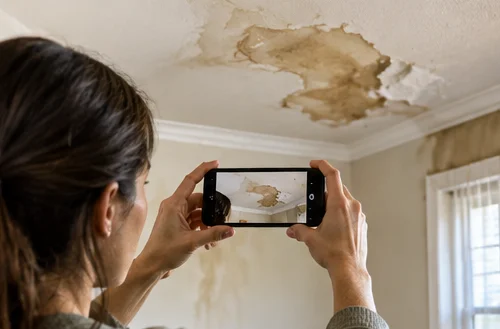
- Take photos and videos. Document both the overall damage and close-ups, room by room, before cleanup begins.
- Locate your policy information. Find your policy number and declarations page — you’ll need them when you contact your insurer.
- Create a damage inventory. A written (or typed) list of what was damaged or destroyed, with rough age and value, is far more useful to have upfront than to reconstruct later.
- Save receipts. This includes receipts for temporary repairs and, if you need to stay elsewhere, additional living expenses.
Exactly which of these your policy requires can vary, so when in doubt, ask your agent or insurer directly.
How to File a Homeowners Insurance Claim Step by Step
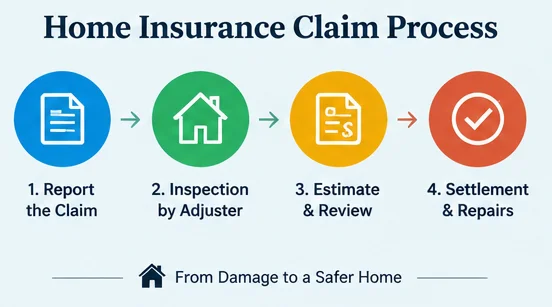
Step 1 — Review your homeowners insurance policy
Before you call your insurer, take a few minutes to review your declarations page: your coverage types, deductible, and any endorsements or exclusions that might apply to your situation.
Step 2 — Document the damage
Photograph and video the damage thoroughly, and start your written inventory of anything destroyed or damaged, including approximate age and value where you can estimate it.
Step 3 — Contact your insurance company or agent promptly
Report the loss as soon as reasonably possible. Many policies include a “prompt notice” requirement, and reporting quickly helps avoid later disputes about when or how the damage occurred.
Step 4 — Provide the requested claim information
Your insurer will typically ask for your policy number, contact information, the date and time of the loss, and a description of what happened.
Step 5 — Record your claim number and communications
Once your claim is opened, you’ll usually receive a claim number. Keep a simple log of every call and email — date, who you spoke with, and what was discussed.
Step 6 — Make necessary temporary repairs when appropriate
If you haven’t already, take reasonable steps to prevent further damage, and keep every receipt.
Step 7 — Prepare for the insurance adjuster
Organize your photos, inventory, and receipts ahead of the adjuster’s visit so you can walk them through the damage efficiently and answer their questions.
Step 8 — Review the insurer’s estimate
Once the adjuster completes their assessment, your insurer will typically provide a written estimate. Compare it against your own documentation and, if you’ve obtained one, a contractor’s estimate.
Step 9 — Understand the settlement/payment
Ask your insurer to explain how the payment is calculated, whether it’s a single payment or multiple payments, and whether your mortgage lender is involved (more on this below).
Step 10 — Keep records until the claim is fully resolved
Hold onto everything — correspondence, estimates, receipts, and the final settlement letter — until repairs are complete and any supplemental claims are settled.

What Information Do You Need to File a Home Insurance Claim?
A practical checklist of what insurers commonly ask for:
- Policy number
- Your contact information
- Date and time the loss occurred (or was discovered)
- A description of what happened
- Photos and videos of the damage
- A written inventory of damaged or destroyed property
- Receipts for damaged items, when available
- Repair estimates, if you’ve obtained any
- A police or fire report, when applicable (theft, vandalism, fire)
- Receipts for temporary repairs
- Receipts for additional living expenses, if you had to stay elsewhere
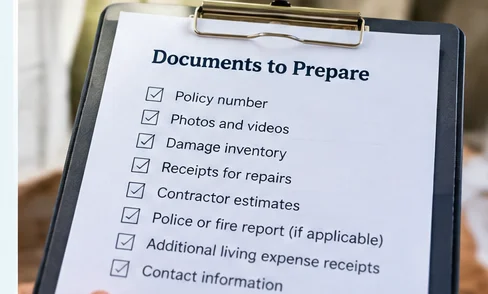
Exactly what’s required varies by insurer and by the type of loss, so treat this as a starting checklist rather than a universal requirement.
What Happens After You File the Claim?
While the details vary, most homeowners insurance claims generally move through a similar sequence:
- Acknowledgment. Your insurer confirms they’ve received your claim and assigns a claim number.
- Claim representative or adjuster assigned. Someone is assigned to evaluate your claim.
- Inspection. The adjuster inspects the damage, often in person.
- Documentation review. Your photos, inventory, and any receipts or estimates are reviewed alongside the adjuster’s findings.
- Estimate prepared. The insurer prepares a repair or replacement estimate.
- Coverage determination. The insurer communicates what’s covered, what isn’t, and why.
- Settlement. Payment is issued according to your policy’s terms.
- Repairs. You proceed with repairs, using licensed contractors as needed.
- Supplemental documentation, if needed. If additional covered damage is discovered during repairs, you can typically submit a supplemental claim.
There’s no universal timeline that applies to every claim — a straightforward claim with clear documentation often moves faster than a complex one, and claim volume after a regional disaster can affect timing industry-wide.
What Does a Home Insurance Adjuster Do?

An insurance adjuster inspects the damage, documents their findings, and prepares an estimate of the cost to repair or replace what’s covered. Depending on your insurer, this might be a staff adjuster (employed by the company), an independent adjuster (contracted by the company), or, in some cases, a homeowner may choose to hire their own public adjuster at their own expense to represent their interests.
The adjuster’s role is to evaluate your claim against your policy’s terms — they aren’t there to advise you personally on whether to accept a settlement. That’s one reason it helps to keep your own thorough documentation: your records and the adjuster’s findings should generally align, and if they don’t, your documentation gives you something concrete to reference when asking questions.
Home Insurance Deductibles Explained
Your deductible is the amount you’re generally responsible for before your insurer pays the remaining covered loss. Deductibles are usually either a flat dollar amount or, for certain perils like wind or hurricane damage in some coastal states, a percentage of your dwelling coverage.
Hypothetical example: Suppose a policy has a flat $1,000 deductible, and the insurer determines a covered loss totals $6,000. In that scenario, the homeowner would generally be responsible for the first $1,000, and the insurer would pay the remaining $5,000, subject to the policy’s other terms. This is a simplified, hypothetical illustration — not a description of how every policy or every insurer calculates a settlement.
Because deductible structures vary by insurer, policy, and sometimes by state or peril, check your own declarations page for the deductible(s) that actually apply to you. For a deeper look at dollar versus percentage deductibles and how to choose an amount, see our homeowners insurance deductible guide.
Replacement Cost vs. Actual Cash Value
Two common ways insurers calculate a settlement for damaged property:
| Replacement Cost Value (RCV) | Actual Cash Value (ACV) | |
|---|---|---|
| What it pays | The cost to repair or replace with new, similar materials | Replacement cost minus depreciation |
| Accounts for wear/age? | No | Yes |
| Typical result | Generally a higher payout | Generally a lower payout |
Hypothetical example: Say a 10-year-old roof with a typical 20-year expected lifespan is damaged. Under ACV, the payout might reflect the roof’s depreciated value at 10 years old. Under RCV, the payout is generally based on the cost to install a comparable new roof, without subtracting for its age. Some RCV policies pay the ACV amount first and reimburse the remaining “recoverable depreciation” after repairs are completed and documented.
Many policies apply different settlement types to different parts of your coverage — for example, replacement cost on the structure of your home and actual cash value on personal belongings. Your declarations page will specify which applies to you. Our full replacement cost vs. actual cash value guide walks through this in more detail, including how recoverable depreciation typically works.
How Are Homeowners Insurance Claim Payments Made?
How you actually receive claim funds can vary quite a bit:
- One payment or several. Some claims are paid in a single amount; others (especially larger ones, or those with recoverable depreciation) are paid in stages.
- Mortgage lender involvement. If you have a mortgage, your lender is often listed on your policy and may be named on the claim check alongside you. According to the Consumer Financial Protection Bureau, lenders sometimes hold insurance proceeds in an escrow-like arrangement and release funds in stages as repairs are completed — the exact process depends on your lender and loan investor, so it’s worth asking your loan servicer directly what their process looks like.
- Contractor payments. In some cases, insurers can pay a contractor directly, though this depends on your insurer’s process and your preference.
- Additional living expenses (ALE). If your policy includes ALE coverage and your home is temporarily uninhabitable, you may be reimbursed for reasonable additional costs like temporary housing.
Because payment procedures depend on your specific policy, insurer, and mortgage arrangement, ask your insurer and, if applicable, your loan servicer to explain exactly how your settlement will be disbursed.
How Long Does a Homeowners Insurance Claim Take?
There’s no single timeline that applies to every claim. Several factors influence how long a claim takes to resolve:
- The severity and complexity of the damage
- Claim volume — a widespread disaster can slow down every insurer’s response times in the affected area
- How complete your documentation is when you file
- How quickly an inspection can be scheduled
- How quickly contractor estimates are available
- Whether there’s a dispute over coverage or cause of loss
- State-specific requirements
- Whether a supplemental claim is needed after repairs begin
Many states have laws (sometimes called “prompt payment” or “unfair claims practices” laws) that set expectations for how insurers must handle claims once certain conditions are met. These requirements differ by state, so if you want to know the specific rules where you live, your state’s Department of Insurance — listed in the NAIC’s state insurance department directory — is the authoritative source.
Common Homeowners Insurance Claim Mistakes to Avoid
A few missteps that can complicate an otherwise straightforward claim:
- Failing to document damage thoroughly before cleanup or repairs begin
- Throwing away damaged property too early, before the adjuster has had a chance to see it
- Losing receipts for temporary repairs or additional living expenses
- Making unnecessary permanent repairs before the insurer has had a reasonable opportunity to inspect
- Failing to take reasonable steps to prevent further damage when it’s safe to do so
- Misunderstanding the deductible, and being surprised by it at settlement time
- Assuming all damage is automatically covered, without checking the policy first
- Not keeping a record of calls and correspondence with the insurer
- Exaggerating or misrepresenting the damage, which can jeopardize the entire claim and, depending on the circumstances, may have legal consequences
What If Your Homeowners Insurance Claim Is Denied?
A denial isn’t necessarily the end of the road. General next steps:
- Read the denial letter carefully. It should cite the specific policy language the insurer relied on.
- Identify the policy language cited. Compare it against your own copy of the policy.
- Request clarification in writing if anything is unclear.
- Gather supporting documentation — additional photos, an independent contractor estimate, or anything else relevant to the dispute.
- Ask about the insurer’s reconsideration or appeal process. Many insurers have an internal process for revisiting a denied or disputed claim.
- Contact your state’s Department of Insurance if needed. The NAIC’s state insurance department directory can help you find the right office, and the NAIC also publishes guidance on how to file a complaint against an insurer.
- Consider professional advice for significant disputes. For high-value or complicated disagreements, some homeowners choose to consult a public adjuster or an attorney who handles insurance disputes. This is general information, not legal advice — for guidance on your specific situation, consult a licensed professional.
When Should You Consider Filing a Home Insurance Claim?
Whether to file is ultimately your decision, and it depends on your specific circumstances. A few factors homeowners commonly weigh:
- The extent of the loss relative to your deductible. If the repair cost is close to or below your deductible, filing may not result in a payout worth the claim on your record.
- Whether the loss appears to be a covered peril under your policy.
- Whether it’s an emergency situation requiring immediate action regardless of the claim decision.
- Policy requirements. Some policies require you to report certain losses within a timeframe, even if you ultimately decide not to pursue a payout.
Whatever you decide, documenting the event — with photos and notes — while it’s fresh is generally a good idea, since it preserves your options either way.
Homeowners Insurance Claim Checklist
A scannable summary of the process, start to finish:
- Confirm everyone is safe; call emergency services if needed
- Take reasonable steps to prevent further damage
- Photograph and video all damage before cleanup
- Create a written inventory of damaged/destroyed property
- Locate your policy number and declarations page
- Contact your insurer or agent to report the loss
- Record your claim number and every communication
- Make only necessary temporary repairs; save all receipts
- Prepare documentation ahead of the adjuster’s visit
- Review the insurer’s written estimate carefully
- Ask how your settlement will be paid, including any mortgage lender involvement
- Keep every record until the claim and any supplemental claims are fully resolved
This article is general educational information about how homeowners insurance claims typically work in the United States. It is not personalized insurance, legal, or financial advice, and it doesn’t cover every insurer’s or state’s specific rules. For guidance on your own policy or claim, contact your insurance company, agent, or your state’s Department of Insurance.
Frequently Asked Questions
How soon should I file a homeowners insurance claim?
Most homeowners policies include a requirement to report a loss promptly, or within a specified window after you discover it. There isn't one universal deadline that applies to every policy, so check your declarations page or ask your agent — but as a general practice, reporting sooner rather than later helps avoid disputes about when and how the damage occurred.
What should I avoid doing before an insurance adjuster arrives?
In general, avoid making permanent repairs or discarding damaged items before the adjuster has had a reasonable opportunity to inspect and document them, when that's practical. The exception is anything needed to prevent further damage or keep people safe — most policies expect you to take reasonable steps to prevent additional loss even before an adjuster visits.
Can I make emergency repairs before the adjuster arrives?
Generally, yes. Reasonable temporary repairs that prevent further damage — like tarping a roof or shutting off water — are typically expected, not discouraged. Photograph the damage before and after the temporary repair, and keep all receipts, since many policies reimburse reasonable costs for preventing additional loss.
What documents do I need for a homeowners insurance claim?
Commonly requested items include your policy number, a description of what happened and when, photos and videos of the damage, a written inventory of damaged or destroyed property, receipts, any repair estimates you've obtained, and a police or fire report if applicable. Exactly what your insurer asks for can vary by claim and policy.
Does filing a homeowners insurance claim increase your premium?
It can, but whether — and by how much — depends on factors like your insurer, your state's regulations, the type and cause of the loss, your claims history, and general underwriting factors in your area. Some claims (like those from a widespread regional disaster) may affect premiums differently than an individual claim. Ask your agent or insurer how a specific claim could affect your policy.
Can a homeowners insurance claim be denied?
Yes. Common reasons include the cause of loss being excluded under the policy, a lapsed or cancelled policy, damage that predates the policy, insufficient documentation, or disagreement over the cause or extent of damage. If your claim is denied, you can ask for a written explanation, gather additional documentation, and ask your insurer about its reconsideration process.
What happens if the repair cost is higher than the insurance estimate?
This is a common situation, especially once a contractor opens up a wall or roof and finds additional damage. You can typically provide your insurer with a contractor's estimate or supplemental documentation and ask them to review it. Many insurers have a formal supplemental-claim process for exactly this scenario, though the specifics vary by company.
How long should I keep home insurance claim records?
A reasonable practice is to keep all claim-related records at least until the claim is fully resolved, repairs are complete, and any supplemental claims are settled. Many homeowners choose to keep the full file — photos, correspondence, receipts, and the final settlement letter — for their own records well beyond that, in case questions come up later.
Sources & References
- Insurance Information Institute — How to File a Homeowners Claim
- NAIC — A Consumer's Guide to Home Insurance
- NAIC — What's the Difference Between Actual Cash Value and Replacement Cost Coverage?
- NAIC — How to File a Complaint Against Your Insurance Company
- NAIC — State Insurance Department Directory
- Consumer Financial Protection Bureau — Escrow and Homeowners Insurance Payments
- FEMA — How to Document Damages After Severe Weather Events