Mortgage Points Explained: How Discount Points Work
What mortgage discount points are, how the upfront-cost-for-lower-rate tradeoff works, the break-even concept, and questions worth asking your lender.
- One discount point generally equals 1% of your loan amount, paid upfront at closing, in exchange for a reduced interest rate.
- How much a point actually reduces your rate varies by lender, loan type, and market conditions — there's no fixed, universal conversion.
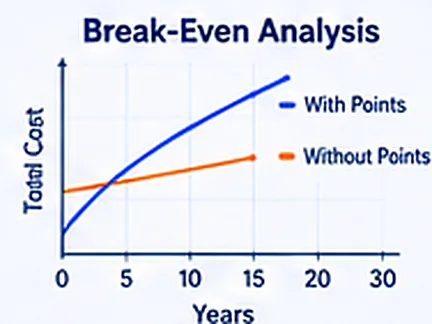
- The break-even point is when your accumulated monthly savings equal what you paid upfront for the points — after that, points may save you money if you keep the loan.
- Lender credits work in the opposite direction: a higher rate in exchange for reduced upfront closing costs.
This article is for general informational purposes and does not constitute financial, insurance, legal, or tax advice.
Table of Contents
- What Mortgage (Discount) Points Are
- The Relationship Between Upfront Cost and Rate
- Lender Credits: The Opposite Tradeoff
- Hypothetical Example (Illustrative Only)
- The Break-Even Concept
- How Time in the Loan Affects the Tradeoff
- Cash Required at Closing
- Questions to Ask Your Lender
- Comparing Offers With and Without Points
- Mortgage Points Checklist
Some lenders offer the option to pay extra at closing in exchange for a lower interest rate. That upfront cost is called a discount point, and whether it’s a good deal depends entirely on numbers specific to your own loan and your own plans. Here’s how the tradeoff actually works — without telling you which way to go.
What Mortgage (Discount) Points Are
A discount point — often just called a “point” — is an upfront fee paid at closing in exchange for a reduced interest rate on your mortgage. According to the CFPB, “one point equals one percent of the loan amount.” On a $300,000 loan, one point would cost $3,000. Points are added to your total closing costs, so they increase what you need to bring to closing.
The Relationship Between Upfront Cost and Rate
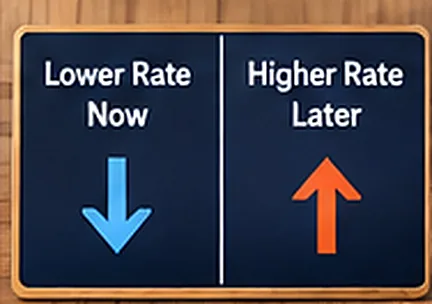
The basic logic is straightforward: paying points upfront should get you a lower rate than the same loan with no points, all else being equal. As the CFPB puts it, “a loan with one point should have a lower interest rate than a loan with zero points, assuming both loans are offered by the same lender and are the same kind of loan.”
What’s genuinely important — and what this guide will not do — is state a specific number for how much a point lowers your rate. The CFPB is explicit that “the amount that your interest rate is reduced depends on the specific lender, the kind of loan, and the overall mortgage market.” That relationship changes across lenders and over time, so any fixed number you might see elsewhere shouldn’t be treated as universal. Ask your own lender for their specific rate options with and without points.
Lender Credits: The Opposite Tradeoff
Where points mean paying more upfront for a lower rate, lender credits work in the reverse direction — you accept a somewhat higher interest rate in exchange for the lender covering part of your closing costs. This can reduce the cash you need at closing, at the cost of paying more in interest over the life of the loan. It’s worth asking your lender about both directions of this tradeoff, not just one.
Hypothetical Example (Illustrative Only)
Say a lender offers a borrower two versions of the same loan:
- Option A: No points, a somewhat higher rate, lower cash due at closing
- Option B: One or more points paid upfront, a somewhat lower rate, higher cash due at closing
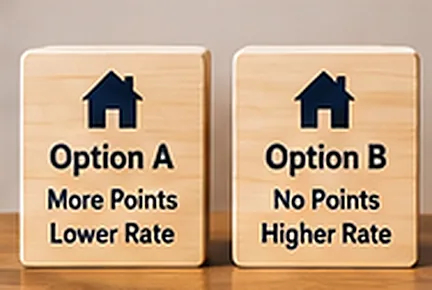
If Option B costs more upfront but saves the borrower a certain amount every month, there’s a point in time — the break-even point — where the accumulated monthly savings catch up to and exceed the upfront cost. Before that point, Option A would have cost less overall; after it, Option B may come out ahead, assuming the borrower keeps the loan that long. (These figures are entirely illustrative — a real comparison requires actual numbers from a lender.)
The Break-Even Concept
The break-even point is simply the moment your monthly savings from a lower rate add up to equal what you paid for the points. The CFPB recommends asking a loan officer to show you two options — with and without points — and to calculate total costs “over a few different possible timeframes,” rather than relying on a single projection.
How Time in the Loan Affects the Tradeoff
This is the single biggest factor in whether points tend to make sense for a given borrower: how long you expect to keep the loan.
- If you keep the loan well past the break-even point, the lower rate has more time to accumulate savings beyond what you paid upfront.
- If you sell or refinance before reaching break-even, you likely won’t recover the full upfront cost through monthly savings.
Nobody can predict with certainty how long they’ll keep a given loan — job changes, family needs, and market conditions can all shift those plans. That uncertainty is part of why this decision is personal rather than formulaic.
Cash Required at Closing
Because points are paid upfront, choosing to buy them increases your total closing costs and the cash you need on hand at closing. It’s worth weighing this against your other closing costs and cash reserves — even if the long-term math favors points, it only works if you can comfortably afford the upfront cost without straining your finances elsewhere. Our guide to closing costs covers how points fit into your broader cash-to-close total.
Questions to Ask Your Lender
- What is my rate with zero points, and what is it with one point (or more)?
- Exactly how much does each option cost me at closing?
- What’s the break-even point for this specific tradeoff, in months or years?
- Are these points guaranteed to reduce my rate, or are they a different kind of fee?
- What would my costs look like if I sold or refinanced in 3, 5, or 10 years?
Comparing Offers With and Without Points
| Compare this | Why it matters | |
|---|---|---|
| Upfront cost | Total closing costs with vs. without points | Shows the real cash difference at closing |
| Monthly payment | Principal & interest with vs. without points | Shows your ongoing savings, if any |
| Break-even point | Months/years until savings equal the upfront cost | Tells you how long you’d need to keep the loan to benefit |
| Total cost over time | 5-year and full-term cost estimates (Loan Estimate, page 3) | Gives a broader comparison than the monthly payment alone |
Mortgage Points Checklist
- Ask your lender for exact rate-and-cost options with and without points
- Calculate (or have your lender calculate) the break-even point for your specific numbers
- Consider how long you realistically expect to keep this loan
- Confirm the points you’re being offered actually reduce your rate, not just a fee with a similar name
- Weigh the upfront cost against your available cash and other closing costs

This guide deliberately stops short of telling you whether to buy points — that call depends on numbers specific to your loan, your finances, and how long you plan to stay. For the fuller picture of how your monthly payment and loan terms fit together, see our guide to how mortgages work, and for where points appear on your official paperwork, see our guide to reading a Loan Estimate.
Frequently Asked Questions
How much does one point cost?
One point generally equals 1% of your loan amount. On a $300,000 loan, for example, one point would cost $3,000, paid at closing. This part of the calculation is straightforward — it's the rate reduction from paying that point that varies.
How much will my rate go down if I buy a point?
This varies by lender, loan type, and the overall mortgage market at the time — there is no fixed, universal amount by which one point reduces your rate. The only way to know the real number for your situation is to ask a specific lender to show you their actual rate options with and without points.
What is the break-even point?
It's the point in time when your total monthly savings from a lower rate equal what you paid upfront for the points. Before break-even, you're still 'behind' on the tradeoff; after break-even, the lower rate may be saving you more than the points cost, assuming you keep the loan that long.
Are points worth it?
That depends on factors specific to you — primarily how long you expect to keep the loan, but also your available cash at closing and your broader financial priorities. This guide deliberately doesn't tell you whether to buy points, since that's a personal decision best made with your own numbers and, ideally, a conversation with a loan officer or financial advisor.
What if I sell or refinance before reaching the break-even point?
If you sell or refinance before break-even, you generally won't have recovered the full upfront cost of the points through your monthly savings — meaning the points may not have been worth it financially, in hindsight, for that shorter timeframe. This is exactly why your expected time in the home matters so much to this decision.
Are lender credits the opposite of points?
In terms of the tradeoff direction, yes — lender credits generally mean accepting a higher interest rate in exchange for reduced closing costs, while points mean paying more upfront for a lower rate. Which direction makes sense, if either, depends on your cash availability at closing and your plans for the loan.
Does every lender use the word 'points' the same way?
No — and the CFPB specifically flags this. Some lenders use 'points' to refer to any upfront fee calculated as a percentage of the loan amount, whether or not it actually reduces your interest rate. Always confirm directly with a lender that a 'point' you're being offered genuinely lowers your rate before treating it as a rate-buydown.