How to Read a Loan Estimate: A Step-by-Step Guide
A page-by-page walkthrough of the standardized U.S. Loan Estimate — loan terms, projected payments, costs, and how to compare offers from different lenders.
- The Loan Estimate is a standardized three-page form every mortgage lender must provide, making it possible to compare offers from different lenders apples-to-apples.
- Page 1 covers your loan terms and projected monthly payments; page 2 breaks down closing costs; page 3 covers comparisons and lender contact information.
- Some costs on the Loan Estimate can change before closing; others are limited in how much they're allowed to change under federal rules.
- Comparing the same sections across Loan Estimates from multiple lenders is one of the most effective ways to shop for a mortgage.
This article is for general informational purposes and does not constitute financial, insurance, legal, or tax advice.
Table of Contents
Every mortgage lender in the U.S. is required to give applicants the same standardized, three-page disclosure — the Loan Estimate — within a set number of days of applying. It’s designed specifically so you can compare offers from different lenders without needing a finance degree. Here’s how to actually read it, page by page.
Page 1: Loan Terms and Projected Payments
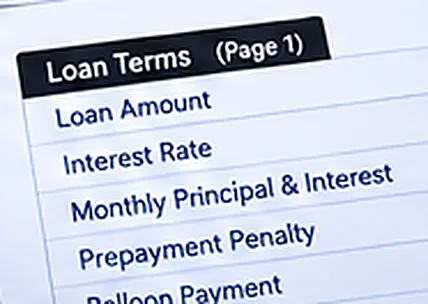
Loan Amount, Interest Rate, and Principal & Interest
The top of page 1 shows your basic loan details: the borrower’s name, the property address, the loan amount, purpose, product type, and loan term. Below that, you’ll find your interest rate and your principal & interest payment — the core cost of borrowing, before taxes, insurance, or mortgage insurance are added in.
Prepayment Penalty and Balloon Payment
Page 1 includes a section asking whether the loan has certain risky features:
- Prepayment penalty — a fee the lender could charge if you pay off the loan early. If present, the CFPB recommends asking your lender about your other options.
- Balloon payment — a final payment that’s a lump sum much larger than your regular monthly payments, sometimes tens of thousands of dollars. If present, this is also worth discussing directly with your lender.
Many loans have neither feature, but it’s worth confirming rather than assuming.
Projected Payments
This section shows your estimated total monthly payment — not just principal and interest, but also estimated amounts for mortgage insurance (if applicable — see our guide to PMI if you’re not sure whether it applies to you), property taxes, and homeowners insurance, if those are collected through escrow. If your loan is an adjustable-rate mortgage, this section may show how your payment could change after the introductory period.
Estimated Closing Costs and Estimated Cash to Close
Near the bottom of page 1, you’ll see summary totals for your estimated closing costs and estimated cash to close — with full detail on both appearing on page 2. Our guide to mortgage closing costs explains what typically makes up these totals.
Page 2: Closing Cost Details
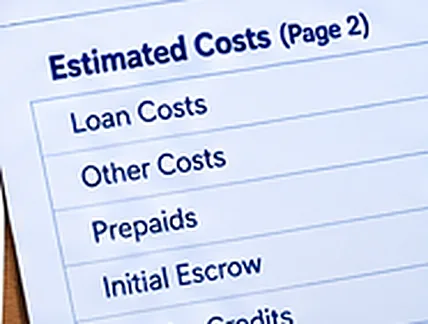
Loan Costs
This section splits into three parts:
- Origination charges — fees your lender charges for processing and underwriting your loan. Not something you can shop for separately.
- Services you cannot shop for — third-party services the lender selects on your behalf, like certain required inspections.
- Services you can shop for — services, like title insurance in many states, where you may choose your own provider.
Other Costs
This section covers items outside the lender’s direct loan costs:
- Taxes and other government fees — recording fees and, where applicable, transfer taxes
- Prepaids — items like prepaid homeowners insurance premiums and prepaid interest
- Initial escrow payment at closing — the deposit that funds your escrow account cushion
- Other — any additional costs specific to your transaction, such as owner’s title insurance if you choose to purchase it
Calculating Cash to Close
Page 2 ends with a calculation that combines your loan costs and other costs, then adjusts for your down payment, any deposits already made (like earnest money), and any seller or lender credits — arriving at your total estimated cash to close.
Page 3: Comparisons and Lender Information

Comparisons
This section is built specifically for shopping around. It typically includes:
- In 5 years — an estimate of the total amount you’d have paid, and how much of your principal you’d have paid down, after five years
- Annual Percentage Rate (APR) — your interest rate plus certain other loan costs, expressed as a yearly rate
- Total Interest Percentage (TIP) — the total amount of interest you’d pay over the loan term, expressed as a percentage of your loan amount
Other Considerations
This section covers additional items, such as whether the lender intends to service your loan directly or transfer servicing, whether the loan can be assumed by a future buyer, and information about late payment fees.
Loan Officer and Lender Contact Information
The form closes with the lender’s and loan officer’s contact information, including their NMLS (Nationwide Multistate Licensing System) identification number — useful for verifying the lender and loan officer’s licensing.
Comparing Loan Estimates From Different Lenders
| What to compare | Where to find it |
|---|---|
| Loan amount and interest rate | Page 1, top section |
| Estimated total monthly payment | Page 1, Projected Payments |
| Total estimated closing costs | Page 1 summary / Page 2 detail |
| Estimated cash to close | Page 1 summary / Page 2 calculation |
| APR and Total Interest Percentage | Page 3, Comparisons |
| 5-year cost estimate | Page 3, Comparisons |
Lining up these figures side by side — for Loan Estimates received around the same time, since rates can move daily — is one of the most effective ways to see genuine differences between lenders rather than comparing a single number out of context.
A Few Things to Keep in Mind
- The Loan Estimate is based on the information available when it’s issued — it is not a guarantee of your final terms.
- Some figures are allowed to change before closing under specific circumstances; others are more tightly limited.
- Your final terms are confirmed in a separate document, the Closing Disclosure, which you’ll receive before closing and can compare directly against your original Loan Estimate.
Loan Estimate Review Checklist
- Confirm the loan amount, rate, and term match what you expected
- Check for a prepayment penalty or balloon payment
- Review your estimated total monthly payment, not just principal and interest
- Compare total closing costs and estimated cash to close across lenders
- Note the APR and 5-year cost estimate on page 3 for a broader comparison
- Ask your loan officer to explain anything unclear before moving forward

Once you’ve compared your options and moved forward with a lender, your next stop is understanding the fees themselves in more depth — see our guide to mortgage closing costs — and, if a lender offered you the choice, our guide to mortgage points explains the upfront-cost-for-lower-rate tradeoff you may see reflected in your Loan Estimate.
Frequently Asked Questions
Is the Loan Estimate the same as a final approval?
No. A Loan Estimate reflects the lender's estimate of your loan terms and costs based on the information available at the time — it is not a guarantee of final approval or final terms. Your actual terms are confirmed later, in your Closing Disclosure, after full underwriting.
How soon after applying should I receive a Loan Estimate?
Lenders are generally required to provide a Loan Estimate within a set number of business days after receiving your application — this is a federal requirement, not something that varies by lender choice. If you haven't received one in a reasonable time after applying, follow up with your lender directly.
What's the difference between my interest rate and the APR on page 3?
Your interest rate is the cost of borrowing the principal amount. The APR (annual percentage rate) is generally meant to reflect your interest rate plus certain other loan costs, expressed as a yearly rate — which is why it's typically a bit higher than the interest rate alone. Comparing APRs can be one useful way to compare offers, alongside comparing the actual dollar totals.
Can lenders change the costs on my Loan Estimate?
Some costs are allowed to change under specific circumstances (like choosing a different service provider for a shoppable service, or new information about the property or your finances); others are limited in how much they can increase. If you see a large, unexplained change between your Loan Estimate and your final Closing Disclosure, ask your lender to explain it directly.
How do I actually compare Loan Estimates from different lenders?
Line up the same sections side by side: loan amount and rate, monthly principal and interest, estimated total monthly payment, total closing costs, and estimated cash to close. Page 3's 'in 5 years' figure and APR can also help you compare the overall cost of different offers over a common timeframe, rather than looking at any single number in isolation.
What should I do if I don't understand a line item?
Ask your loan officer to explain it in plain terms before you proceed. The Loan Estimate is designed to be a standardized, comparison-friendly document, but the terminology can still be unfamiliar — there's no substitute for asking the specific lender providing your specific estimate.