Fixed-Rate vs. Adjustable-Rate Mortgage: What's the Difference?
How fixed-rate and adjustable-rate mortgages differ — initial rates, adjustment periods, indexes and margins, rate caps, and the tradeoffs of each.
- A fixed-rate mortgage keeps the same interest rate for the entire loan term, so principal-and-interest payments don't change.
- An adjustable-rate mortgage (ARM) typically starts with a lower introductory rate that can change at set intervals after an initial period, based on an index plus a margin.
- ARMs generally have rate caps limiting how much the rate can change at each adjustment and over the life of the loan — but the specific caps vary by loan.
- Neither option is universally better. The right choice depends on how long you plan to keep the loan, your risk tolerance, and your own financial situation.
This article is for general informational purposes and does not constitute financial, insurance, legal, or tax advice.
Table of Contents
One of the first choices most homebuyers face is whether to take a fixed-rate or an adjustable-rate mortgage. Both are common, both are legitimate options depending on the situation, and neither is objectively “correct.” Here’s how each actually works, so you can weigh the tradeoffs with your lender and your own financial picture in mind.
Fixed-Rate Mortgages
With a fixed-rate mortgage, the interest rate is set when you take out the loan and does not change for the life of the loan. Your principal-and-interest payment stays the same every month, for the entire term — whether that’s 15, 20, or 30 years.
That predictability is the main appeal: you know exactly what your principal-and-interest payment will be five, ten, or twenty years from now, regardless of what happens to interest rates in the broader market. (Your total monthly payment can still shift if your property taxes or insurance premiums change, since those are typically billed separately through escrow — but the loan payment itself is locked in.)
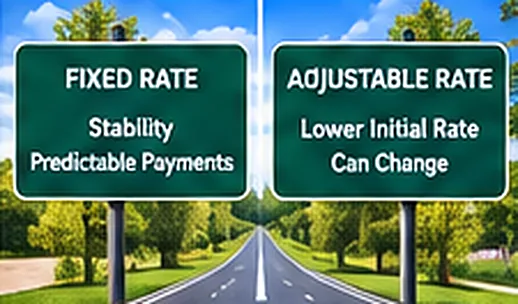
Adjustable-Rate Mortgages (ARMs)
With an adjustable-rate mortgage, the interest rate can go up or down over time. According to the CFPB, lenders generally charge lower initial rates for ARMs than for fixed-rate mortgages — but that introductory rate is temporary. It typically holds for an initial period (commonly a few years, though this varies by loan), after which the rate adjusts at set intervals for the remainder of the term.
The Initial Rate and Adjustment Period
The initial rate is what you pay during the introductory period. Once that period ends, the rate recalculates on a schedule called the adjustment period — for example, annually. How long the initial period lasts, and how often adjustments happen afterward, depends on the specific ARM product (you’ll sometimes see this expressed as numbers in the loan’s name, describing the initial fixed period and adjustment frequency).
Index and Margin
After the initial period, an ARM’s rate is generally calculated as an index (a benchmark interest rate that reflects broader market conditions) plus a margin (a fixed amount the lender adds). This combined figure is sometimes called the fully indexed rate. Which index a given loan uses, and the exact margin, is set by the lender and loan agreement — it varies by lender, loan program, and the overall market, so there’s no single “typical” figure that applies to every ARM.
Rate Caps
Most ARMs include rate caps that limit how much the interest rate can change:
- A cap on how much the rate can increase at any single adjustment
- A cap on the total increase allowed over the life of the loan
These caps protect borrowers from unlimited rate swings, but the specific numbers are set by the individual loan — reviewing your own loan’s cap structure (not a generic example) is the only way to know your real exposure.

Side-by-Side Comparison
| Fixed-Rate Mortgage | Adjustable-Rate Mortgage (ARM) | |
|---|---|---|
| Initial rate | Typically higher than an ARM’s introductory rate | Often lower for an initial period |
| Rate stability | Locked for the entire loan term | Can change after the initial period, at set intervals |
| Payment predictability | Principal & interest payment stays the same | Principal & interest payment can rise or fall after adjustments |
| Long-term cost | Depends on how rates move over the loan’s life | Depends on the index, margin, and rate caps at each adjustment |
| Best suited for | Borrowers who value payment certainty or plan to stay long-term | Borrowers comfortable with future rate uncertainty, often those expecting to move or refinance |
This table describes general tradeoffs. It is not personalized advice, and actual loan terms — rates, caps, indexes, and eligibility — vary by lender, loan program, borrower qualifications, and market conditions at the time you apply.
Payment Uncertainty: The Real Tradeoff
The core tradeoff isn’t complicated: a fixed-rate loan trades a (typically) higher starting rate for long-term certainty. An ARM trades a lower starting rate for the possibility — not certainty — that your rate and payment could rise later. The CFPB’s consumer handbook on ARMs specifically warns against assuming you’ll be able to sell or refinance before an adjustment hits, since property values can decline or your financial situation can change in ways that limit those options when you need them.
Long-Term Considerations
A few things worth thinking through, without a one-size-fits-all answer:
- How long do you expect to keep this loan? A shorter expected timeline changes the calculus around an ARM’s introductory-rate savings versus a fixed rate’s certainty.
- How would a payment increase affect your budget? If an ARM’s rate adjusts upward at the maximum allowed by its caps, would that payment still be manageable?
- What’s your tolerance for uncertainty? Some borrowers strongly prefer a known, unchanging payment even if it costs more upfront; others are comfortable with variability in exchange for lower initial costs.
- What do the specific numbers say? Ask any lender offering an ARM for the exact index, margin, adjustment schedule, and cap structure — not general industry figures — before comparing it to a fixed-rate offer.
Choosing Between Them
This guide intentionally does not tell you which mortgage type is right for you — that depends on details specific to your finances, timeline, and risk tolerance that only you (and, ideally, a loan officer or financial advisor familiar with your full situation) can weigh. What’s most useful is understanding the mechanics well enough to ask informed questions and compare real, lender-specific numbers rather than assumptions.

If you’re still working through the basics of how a mortgage payment is structured, our guide to how mortgages work is a good starting point. And once you’re comparing real offers, our guide to reading a Loan Estimate walks through exactly where to find a loan’s rate type, adjustment terms, and projected payments on the standardized form every lender must provide.
Frequently Asked Questions
Do ARMs always start with a lower rate than fixed-rate mortgages?
Lenders generally charge lower initial rates on ARMs than on comparable fixed-rate mortgages, according to the CFPB, but this isn't a guarantee for every loan or every moment in the market. Comparing actual offers from lenders is the only way to know the real difference for your situation.
What is an adjustment period?
The adjustment period is how often an ARM's interest rate can change after the initial fixed period ends — for example, every six months or every year, depending on the specific loan. The initial period before the first adjustment (sometimes 3, 5, 7, or 10 years) is also set by the specific loan terms.
What are index and margin on an ARM?
An ARM's interest rate after the initial period is generally based on an index (a benchmark rate that moves with broader market conditions) plus a margin (an amount the lender adds on top). The combined figure is sometimes called the fully indexed rate. Which index a specific loan uses, and the size of the margin, varies by lender and loan program.
What are rate caps and why do they matter?
Rate caps limit how much an ARM's interest rate can increase. There are commonly caps on how much the rate can rise at each individual adjustment, and a separate lifetime cap limiting the total increase over the life of the loan. The specific cap structure varies by loan, so it's important to review your own loan's terms rather than assume a standard figure.
Could my ARM payment go down instead of up?
It's possible — since an ARM's rate moves with an index, it can decrease as well as increase at an adjustment, depending on where the index stands at that time. However, borrowers generally shouldn't assume a decrease; rate caps limit the size of any given change, but they don't guarantee a direction.
Is it risky to assume I'll sell or refinance before my ARM's rate adjusts?
The CFPB specifically cautions against this. Property values can decline, refinancing options can become less favorable, or your financial situation can change in ways that make selling or refinancing harder than expected — so relying on that plan alone carries risk.
Can I switch from an ARM to a fixed-rate loan later?
Generally, only through refinancing — replacing your existing loan with a new one, which involves its own approval process, costs, and current market rates. It isn't an automatic option, and refinancing isn't guaranteed to be available or advantageous when you want it.